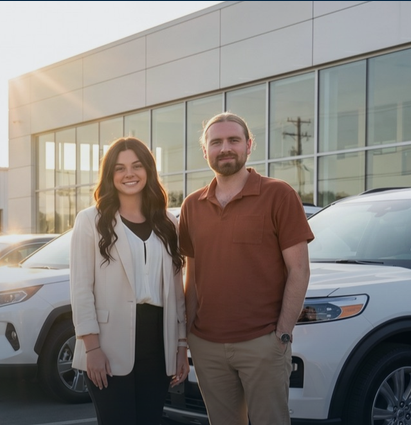
Two Edmonton salespeople became the brand. The leads cost about twenty dollars each.
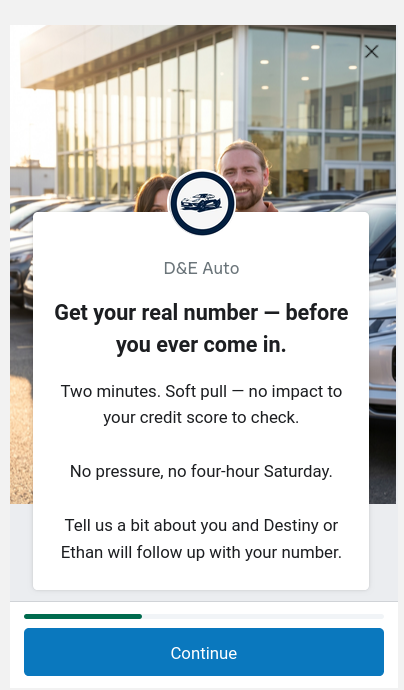
Destiny makes it easy. Ethan knows the cars. ARK built D&E Auto around the two of them rather than around a dealership, and ran three concepts in three placements. A logo can be copied and an offer matched; two named people cannot be duplicated.
Edmonton is an intensely competitive automotive market where dealerships compete on much of the same inventory, financing, incentives and media. The opportunity was not to make another dealership ad louder. It was to take two top-performing sales representatives and build the customer-facing brand around the people a buyer would actually deal with.
The Inversion
Most automotive advertising puts the vehicle, the payment, the discount or the dealership logo at the centre. For D&E Auto we inverted that hierarchy. The customer meets Destiny and Ethan first. The cars come second.
That gave the brand a clear architecture. Destiny makes it easy — the human side of the transaction, for first-time, nervous or dealership-weary buyers. Ethan knows the cars — product knowledge and sourcing, understanding what the vehicle has to do and finding options beyond whatever happens to be on the lot. They are not interchangeable salespeople. They are two different reasons to trust the same brand.
The Identity
ARK developed the name, the joint-brand concept, the logo and visual identity, the colour system, art direction, campaign photography, website creative direction, messaging and the paid-social creative — as one system rather than a set of isolated ads.
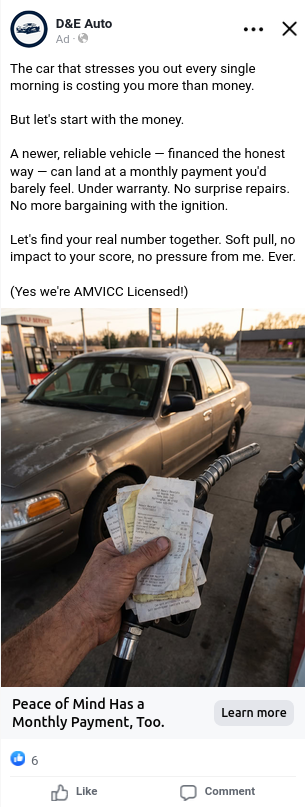
The identity had to survive two opposite environments: brand-first surfaces like the website and photography, where there is room to tell a story, and performance surfaces like a fast-scrolling feed, where the message has seconds to earn attention. The same people, colours, tone and promise had to hold in both.
Three Concepts, Three Placements
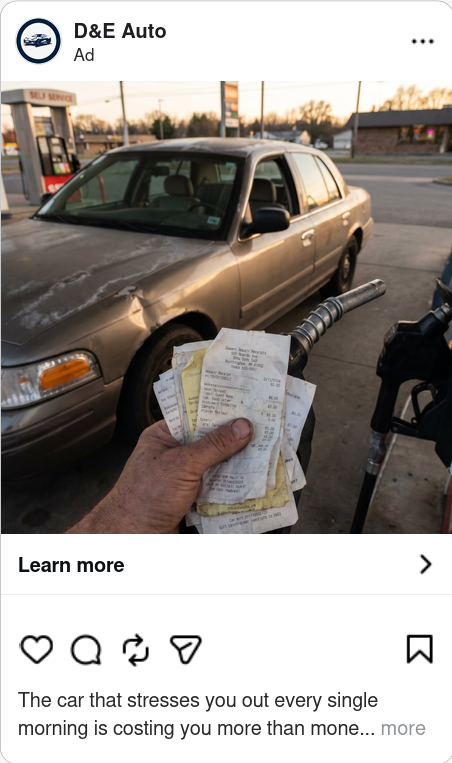
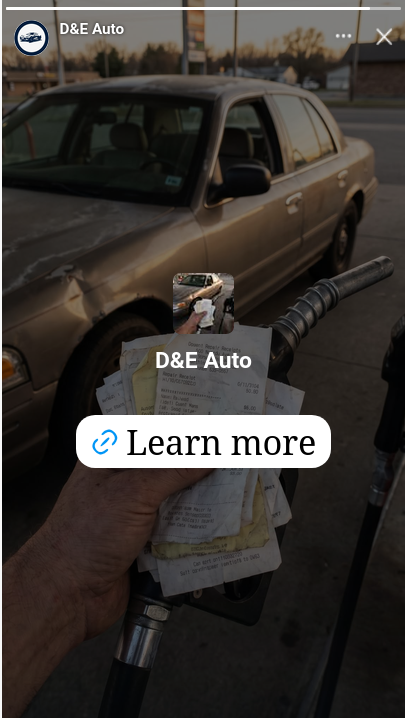
Three core paid-social concepts, each adapted for Facebook Feed, Instagram Feed and Instagram Stories. Not one generic asset resized nine times — each placement was built for different viewing behaviour, pacing, framing and available screen space.
That made every impression do two jobs at once: generate the immediate inquiry, and build recognition for Destiny and Ethan as automotive personalities in Edmonton. A lead can be won once. A recognisable sales-rep brand compounds.
Brand Before Lead
The campaign was still accountable to performance, and roughly twenty dollars average cost per lead gave a clear acquisition benchmark in a market where that is hard to hold.
But every ad, photograph, colour, headline and website interaction was building memory around the same two people. The logo can be copied. The vehicle offer can be matched. The placement can be bought by every competitor in Edmonton. Destiny and Ethan cannot be duplicated — that is the durable advantage the campaign was designed around.
Nine questions we asked before a frame was shot.
- Why does this campaign exist? Two top-performing reps in a commoditised market had no brand of their own, and the dealership brand was not a differentiator.
- Who are we trying to move? Edmonton buyers who are tired of dealership pressure and would rather choose a person than a lot.
- What should they believe? You are choosing who helps you buy the car, not which building you walk into.
- What is the central creative concept? Build the brand around the salespeople instead of hiding them behind it.
- What should it feel like? Two people, photographed properly, with a colour system that survives a fast-scrolling feed.
- How is it made? Professional campaign photography, an identity system, and three creative concepts adapted to three placements.
- Where does it run? Facebook Feed, Instagram Feed and Instagram Stories.
- What did the market do? Roughly twenty dollars average cost per lead in a highly competitive automotive market.
- What changes next? The personal-brand model scales to a team. That question became MyRide.
What worked, what did not, and what has not been measured.
Worked
- Roughly $20 average cost per lead in a market where dealerships compete on identical inventory and incentives.
- The identity held in both brand-first and performance environments without being redrawn.
- Paid acquisition doubled as personal brand building — the spend bought recognition as well as inquiries.
Did not
- A two-person brand does not scale past two people. The model had a ceiling built into it from the start.
- The identity system, campaign photography and site screens were produced but never archived, so the case study cannot show its own brand work.
- Lead-to-sale rate. ARK measured acquisition cost, not what the dealership did with the leads afterwards.
- Recognition lift for Destiny and Ethan as individuals — the compounding effect the campaign was designed around was never instrumented.
- Cost per sold unit.
From the notebook.
The salesperson can be the brand.
- ARK
- Automotive marketing treats sales representatives as interchangeable endpoints — the ad belongs to the dealership, the lead belongs to the CRM, and a salesperson happens to receive it. Invert that and the acquisition asset becomes a person. The logo can be copied, the offer can be matched, the placement can be bought by every competitor in the market. Two named people cannot be duplicated.
If there is a limit, test it.
- SOURCE
- Seth Godin
- IDEA
- Categories have boundaries that everyone inside them treats as physics.
- ARK
- Most category boundaries are habits with tenure. The test is cheap: name the boundary out loud, then ask what would break if we crossed it. Usually the answer is a process, not a law.
- STRATEGY
- Bichar Hamid
- CREATIVE DIRECTION
- Tommy Pham
- CLIENT
- Destiny Hutchings & Ethan Bardsley
Not the deliverable — the problem. Tell us what the business needs to be true and we will tell you what should exist in the market for that to happen.
CLICK HERE ►